The Free Lunch Formula: The impacts of changes to CEP and the National School Lunch Program in Central Texas
WACO, Texas (KWTX) - Every school in Central Texas, from Mills County to Freestone, uses the National School Lunch Program to receive federal funding for student breakfast and lunch meals.
Any student can apply for a free meal plan, but only students that meet the income guidelines to get federal aid will receive a free meal or meals at reduced rates.
Each family must submit an application that will prove their status, but dealing with hundreds of applications can be tedious for school districts to collect and may take time for students to officially have their meals provided for.
Now, there is a program within the National School Lunch Program that eliminates the need for an application from parents and school districts can have reimbursements on all meals for every student.
The community eligibility provision, also known as CEPs, eliminates the need for a lunch application and streamlines receipts of reimbursements for meals served to enrolled students.
If they have enough students that need help getting meals every day, districts can receive federal reimbursements to make sure every student, no matter their home status, can get breakfast or lunch.
The CEP is like an all-access pass for all students in the school to receive a free meal.
If your school has it, they can save money to invest in meals and staff compensation.
But not all schools can do this, so how is it decided?
It boils down to a formula to figure out if districts are eligible.
Districts must first identify their economically disadvantaged student population and compare that to how many students are enrolled.
IDENTIFIED STUDENT PERCENTAGE = # IDENTIFIED STUDENTS / # ENROLLED STUDENTS
This number is called an identified student percentage, or ISP, and this is what districts go by to see if they are eligible to get a reimbursement by Congress.
In the past, if your ISP was over 40 percent, your school would be eligible to apply for the CEP, but the percentage to be eligible has changed in October 2023.
After you have this number, districts need to see if they will benefit from getting an all-access pass, and to find that out, congress has set the rules.
Once you have your ISP, congress determines a value called a multiplier that districts need to calculate, this year it is 1.6.
And the number we get at the end is how districts find out what percentage of meals can be claimed at the higher federal reimbursement rate and what percentage will receive the lower paid reimbursement rate.
% Meals reimbursed at federal free rate = ISP × 1.6
% Meals reimbursed at federal paid rate = 100−% meals reimbursed at federal free rate
The more students that need help, the easier it is for school districts to apply for CEP.
However, using CEP must be reasonable for school districts, since they must calculate how much they need to pay from their funding if they do not qualify to be reimbursed entirely from Congress.
Assistant Commissioner of Food and Nutrition for the Texas Department of Agriculture, Lena Wilson, says that before they submit an application to receive CEP “districts have to show they are financially sound” to receive reimbursements.
According to Wilson, 43 percent of Texas uses CEP.
In Central Texas, 45 school districts in our viewing area use CEP and 37 schools do not, according to data from the Food Action and Research Center.
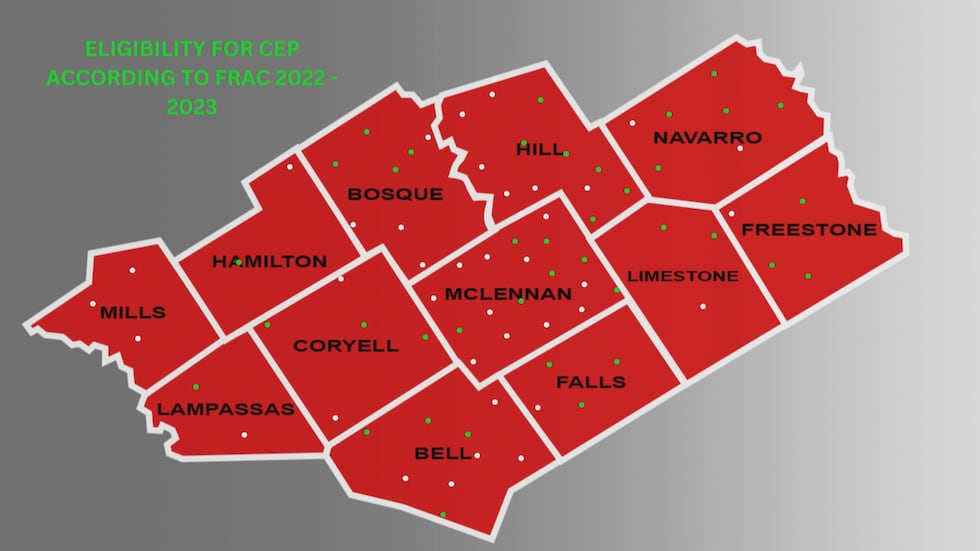
In previous years, the requirement was 40 percent to eligible, but as of October the requirement has dropped to 25 percent.
Wilsons says that lowering the CEP rate “includes more states and districts in the program.”
In 2018 Waco ISD began their transition to the CEP program, and according to the district only saw positive changes.
Food Service Director Clifford Reece says that parents can be reassured knowing their child’s meals are taken care of, and their parents “know their child is going to get a free meal, free breakfast, free lunch, free snack or whatever every day they go to school, and they don’t have to worry about that paperwork.”
Reese says that the money they get back can go towards upgrades that directly benefit their district.
They were able to purchase “a lot of equipment that allows for self-serve, so the kids are doing self-serve fruits and vegetables,” along with “some refrigerators that you can put things like sandwiches and wraps” and other general upgrades to cafeterias.
But with the recent change in the ISP requirements more schools have been eligible to apply for CEPs and Fairfield ISD made the change this academic year.
Child Nutrition Director Crystal Thill says that the decision to switch brings in more money than they had before.
“It makes sense for us financially now so we’re actually coming out a little bit ahead of where we would have been if we were doing normal reimbursement.”
Thill says that their students have noticed the easy process of getting better quality meals, and students are “enjoying the fact that they don’t have to worry about the charges,” and can be relieved knowing that every student is treated the same in the lunch line.
School districts agree that using the formula to find out how much money they can get federally reimbursed can be a game changer for their schools, and that any money that is spent on improving students’ day to day lives is money spent well.
Reese notes that “anytime you have additional resources to run your program, you invest that in the things that are going to directly benefit the kids.”
Copyright 2024 KWTX. All rights reserved.