Measles outbreak in Samoa offers warning about declining U.S. vaccination rates
Remote island nation’s deadly 2019 epidemic killed 83 people, mostly children, as experts warn similar outbreaks could happen in the United States
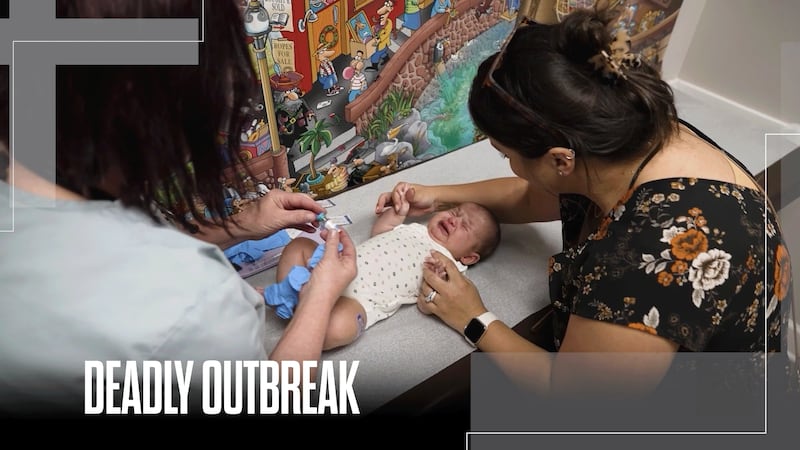
(InvestigateTV) — A deadly measles outbreak that killed 83 people in Samoa offers a stark warning for the United States as vaccination rates decline nationwide, according to health experts.
The 2019 outbreak in the remote South Pacific island nation devastated families and overwhelmed hospitals before an international vaccination campaign ended the crisis. Most of the victims were children.
“It could happen here. It could very much happen here,” Dr. Vija Sehgal, a pediatrician who volunteered with Hawaii’s medical response team during the measles outbreak, said.
Declining vaccination rates raise concerns
According to Johns Hopkins University, 2025 was the worst year for measles cases in three decades. A 2025 university study revealed a nationwide average decline of 2.67% in the measles, mumps and rubella vaccination rate among U.S. children since the start of the pandemic.
The decline puts the average vaccination rate at just over 91%, dropping it further below the 95% herd-immunity threshold needed to prevent outbreaks.
“So, you’re going to see the same thing in rural Georgia and rural Texas and rural Hawaii, New York, anywhere, as you saw in Samoa, as vaccine rates plummet,” said Hawaii Gov. Josh Green, who led the state’s medical response to Samoa. “You will see outbreaks.”
Samoa’s outbreak began with vaccine mistrust
Before the 2019 outbreak, Samoa’s vaccination rate was around 30%.
The already-low vaccine rate was made worse partly by a 2018 incident when two nurses administered measles vaccines mixed with an expired muscle relaxant, killing two infants, according to authorities. Both nurses were sentenced to prison.
“Well, it really shook the trust of the people of the system,” said Dr. Robert Thomsen, deputy director general of Samoa’s Public Health Services.
Samoa got its first confirmed measles case on Sept. 30, 2019, while thousands of people from across the globe were visiting for the Pacific Games and a religious conference.
Public health officials believe it was likely from a visitor from New Zealand, which was experiencing its own outbreak.
“In a matter of two weeks, the numbers just went from zero to thousands,” Thomsen said.
In 53 days, cases jumped to 1,600. By January 2020, the total reached 5,707.
“And the only way that we can best tackle the problem was to push the vaccination levels up,” Thomsen said.
International response saves lives
Within weeks of the outbreak, nearby countries like New Zealand and Australia sent medical teams to aid in the response. The United States did as well.
Hawaii Gov. Green, a longtime emergency room doctor, was then the state’s lieutenant governor and chartered a plane to Samoa with nearly 70 doctors and nurses.
“When we got to Samoa, there was measles everywhere. And people were dying and overflowing the hospitals,” Green said.
New Zealand sent child-sized coffins when Samoa ran out.
Mother’s plea after losing daughter
Elsie Fa’atauu’u lost her 1-year-old daughter Noel Lolesio to measles during the outbreak. The 24-year-old mother was afraid to take her daughter to the hospital as the outbreak spread.
“I see her healthy, and I think, oh no, she’s healthy. She’s fat. It’s OK,” Fa’atauu’u said.
She was afraid that her daughter might get worse if she took her to the hospital. The 1-year-old died from the disease.
“It broke me to a million pieces because she’s my first child,” Fa’atauu’u said.
An intense vaccination campaign in Samoa increased the vaccination rate to 95% by the end of 2019, when the country ended its state of emergency.
Measles remains highly contagious
Measles is one of the most contagious of all known infections, according to Johns Hopkins. It spreads primarily through the air when an infected person coughs, sneezes or talks.
“The air in a room, let’s say this room, here, this exam room. If there was a child with measles here, then the child is taken somewhere else, the room would remain contagious for about two hours,” Dr. Roy Benaroch, a pediatrician, said.
About one in five unvaccinated people who get measles are hospitalized, according to the CDC. The infection can cause a high fever, cough and a rash that typically travels from the forehead down the body.
The disease can also lead to a rare brain disorder.
“And the brain just degenerates, and the children will lose all of their abilities and fall apart in front of your eyes and die. There is no treatment. Not common, but entirely preventable,” Benaroch said.
See the full story by Andy Pierrotti here.
Copyright 2026 Gray Media Group, Inc. All Rights Reserved.