The Lingering War: Vietnam Vets’ battle over Agent Orange
(InvestigateTV) — Fifty years have passed since the end of the Vietnam War, but for countless veterans, the fight never truly ended.
It’s a battle that has moved from the jungles of Southeast Asia to the quiet rooms of VA hospitals and the cold, sterile pages of government paperwork. For these men, the enemy is not a foreign army, but a silent, invisible poison that they believe has been coursing through their bodies for decades, leaving a trail of sickness and disease.
This is the story of their fight for recognition, a struggle against a ticking clock and a bureaucratic wall, centered on a toxic herbicide known as Agent Orange.
A Life of Struggle
In a small Kansas town, Art Gentry’s home is a testament to a life of struggle.
The roof is failing, the front porch sags, and the driveway is in desperate need of repair. At 77, Art can’t do the work himself. His body, much like his house, has seen better days.
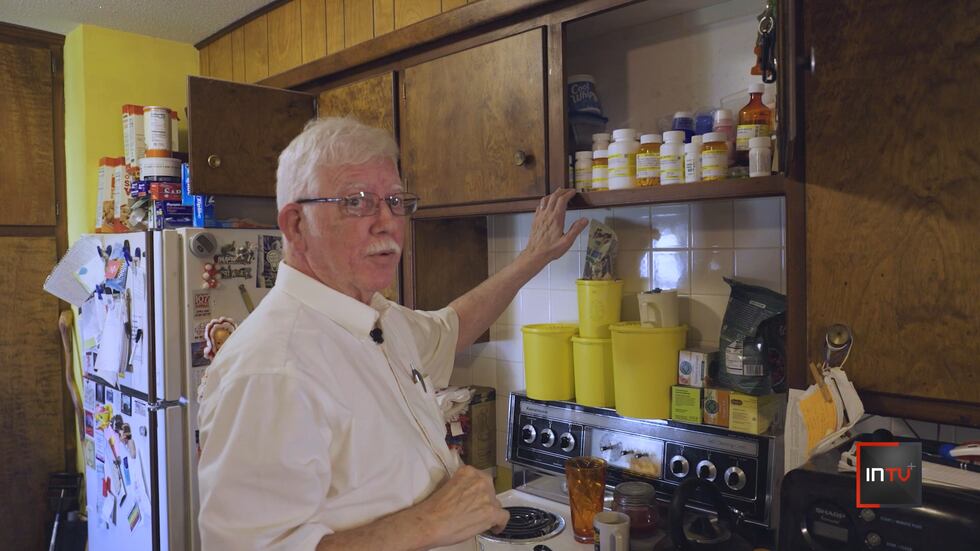
In a kitchen cabinet above his stove, sits what he calls his “branch pharmacy.” Art takes as many as nine medications per day. Each one is working to treat a litany of debilitating health issues.
“Myasthenia gravis was the first big one that hit me really hard,” he explains. “I also have hypertension. I had skin cancer across my forehead. Type 2 diabetes and prostate cancer.”
Those last two diagnoses are crucial.
They are illnesses the U.S. government has officially linked to exposure to Agent Orange, the highly toxic chemical defoliant sprayed during the Vietnam War to eliminate enemy cover. While the U.S. acknowledges the devastating health consequences, from multiple forms of cancer to Parkinson’s disease and diabetes, it has created a strict set of rules for veterans seeking benefits.
How a Veteran is Approved for Additional Benefits
To qualify, a veteran must prove they served in a “presumptive exposure location,” a specific list of places where the government admits the chemical was used or stored.
Art Gentry is convinced he was exposed, but his story doesn’t fit neatly into the government’s predetermined boxes. In 1971, he was stationed at Subic Bay in the Philippines.
An avid swimmer in his youth, he frequently visited the base’s beaches.
“Seven different times before I got told I was in a restricted area that was not posted,” he recalls.
The reason for the restriction, he believes, was its proximity to a leaking chemical storage facility.
“It was near the Agent Orange storage facility that was actually leaking down a ramp into the water there.”
Because Subic Bay is not on the official presumptive exposure location list, the Department of Veterans Affairs (VA) denied Art’s claim for benefits. These benefits could provide thousands of dollars a month to help him fix his home and manage his deteriorating health.
The denial came despite a powerful precedent.
Previously Approved Claims
In 2002, two Marines who also served at Subic Bay filed a claim for Agent Orange exposure.
After a ten-year fight, armed with news reports, documents, and statements from fellow veterans who saw the chemical barrels, the VA granted their benefits. They proved Agent Orange was present at Subic Bay.
So why was their claim approved and Art’s denied?
The VA’s official response is that it makes these decisions on a “case-by-case basis.”
In a statement, the agency maintains its stance that “Agent Orange was not used, transported, stored or tested in Subic Bay,” a position that directly contradicts the outcome of the Marines’ successful case.
This inconsistency leaves veterans like Art in a bureaucratic limbo, forced to re-prove facts that have already been established.
“You have some veterans getting it and others not, and there’s not a real rhyme or reason to it anymore,” says Dan Curry, an attorney who handles veteran disability claims. “It almost seems random.”
Understanding the Scope of the Issue
InvestigateTV+ dug into the VA’s own online database. Since the VA does not specifically track claims from non-presumptive locations, the team manually sifted through records, uncovering more than 500 claims from veterans who served in Subic Bay and now suffer from Agent Orange-related illnesses.
The data revealed a grim pattern: more than half of the claims were denied, most for the simple reason that the veteran had not set foot in Vietnam.
When presented with this data, the VA deferred responsibility for adding Subic Bay to the presumptive list to the Department of Defense (DOD).
The DOD, in turn, would not comment.
This lack of accountability leaves aging veterans feeling abandoned by the very country they served.
“There’s a lot of veterans that will say they’re just going to make me wait and fight,” Curry says. “Wait and fight until I’m dead. And then they don’t have to pay me.”
The Battle Continues for Art and Others
Despite the denials, Art Gentry continues his fight.
He has gathered new evidence, including a signed letter from another veteran who served in Subic Bay and personally witnessed Agent Orange being shipped through the base. He also has a note from his doctor explicitly linking his prostate cancer to the herbicide. However, time may not be on Art’s side.
His cancer is being monitored, and if it worsens, he will need to begin radiation therapy.
Art’s battle is a microcosm of a larger, ongoing tragedy.
A Florida law firm that won the case for the two Marines now has nine or more clients with similar claims from Subic Bay. Those clients have been fighting for benefits for years, ranging from three years up to 34 years.
While Congress has the power to designate new presumptive exposure areas, an inquiry to every member of the Congressional Committee for Veterans Affairs resulted in no on-camera interviews.
The DOD requires a high burden of proof, including shipping logs, dated pictures, and scientific reports, that are nearly impossible for individual veterans to track down decades later.
For now, Art can only hope, fighting a war against time and bureaucracy, long after his service has ended.
Is AI impacting your community? Find out more with InvestigateTV’s mAnIpulated: A Misinformation Nation
Copyright 2025 Gray Media Group, Inc. All rights reserved.