Paralyzed airman takes yearslong military malpractice fight to the Supreme Court
Congress is now trying to help clear the path for active-duty military members to sue for malpractice
Tampa, FL (InvestigateTV) — In basic training, Ryan Carter’s day began with drills and grueling runs before sunrise. Now, each morning begins with a specialized lift hefting him out of bed.
An aide helps him bathe, dress, and sit in a specialized wheelchair as his wife, Casey Cole, doles out the first of four rounds of daily medication and prepares his breakfast.
Their days are filled with doctors’ appointments, physical therapy, and pain - so much pain that there are times Carter says he can’t take it anymore.
It’s a relentless and brutal cycle for the couple, whose lives used to revolve around the ordinarily divine - dinner dates, sporting events, and dog walks in their beloved home city of Baltimore. That all ended in 2018 when Carter, then a staff sergeant with the Maryland Air National Guard, underwent routine spine surgery that left him paralyzed.
“It’s like someone just you know, went in and cut my nerves and just said, ‘Good luck’,” Carter said.

Luck has done little to help the couple in their quest for answers and compensation following Carter’s surgery. Despite allegations of negligence including nearly two dozen failures during the procedure and aftercare, he cannot sue his doctors for medical malpractice. It’s all because of a decades-old court decision that impacts active-duty service members across the nation. It effectively bars them from filing lawsuits against the government.
“The courthouse doors are closed to military service members seeking justice and accountability,” said Chris Casciano, Carter’s attorney.
The legal barrier is something called the Feres Doctrine, which stems from a 1950 Supreme Court decision that limited the ability of active-duty service members to seek damages through tort claims against the military.
The decision was made 25 years before Ryan Carter was even born, and he had no idea it existed when he enlisted in the Air National Guard or when he underwent surgery at Walter Reed National Military Medical Center, the nation’s premier military hospital.
In 2018, a procedure to relieve chronic neck pain went tragically wrong, leaving Carter in need of round-the-clock care.
“The surgeon comes in, pulls me into a private room - doesn’t explain what happened but just said something went wrong and he’s paralyzed,” said Carter’s wife Casey Cole.

Problematic military claims process prompts move toward options in court
Since Carter’s surgery, it’s been a battle for recovery and damages as his family and legal team fight a system designed to stop those in uniform from seeking justice in court.
Congress attempted a workaround, passing the Stayskal Act in 2019. It gave service members like Ryan Carter the ability to file malpractice claims with the military. But InvestigateTV’s reporting has consistently highlighted criticism from service members, advocates, and members of Congress about secrecy and inefficiency within the process.
Right now, malpractice claim decisions are handled entirely behind closed doors by the military, without legal tools like evidence discovery or in-person testimony. The process has been plagued by denials with just a small fraction of claims resulting in payouts according to statistics obtained by InvestigateTV.
A March 2024 report to Congress shows that 141 malpractice claims were processed by the Air Force, Army and Navy between October 2022 and September 2023. Of those, only 10 were settled.
Richard Stayskal, the former Green Beret whose terminal lung cancer was repeatedly missed by military doctors, is the namesake of the law that makes claims possible for active-duty service members. Despite being the face of the legislation, even his claim was denied.
Delays also have been a problem; with individuals profiled by InvestigateTV waiting months or years for decisions. The family of Air Force Master Sergeant Chrystal Stuckey filed a malpractice claim after her death from hydrocephalus, a condition in which fluid collects on the brain.
Despite increasing pain and troubling symptoms, they allege she was repeatedly misdiagnosed for more than a year before she died. The family still hasn’t received a response to its claim.
Ryan Carter also filed a malpractice claim with the military in 2020. Four years later, the family is still waiting for a decision.
“We want accountability. We want justice. We want the ability to get answers to the questions that we have,” Casciano said.
Calls for Supreme Court to weigh in grow with Carter’s case
Casciano has tried every legal avenue, beginning with the lower courts. His original arguments focused on a strange development he discovered in Carter’s military record: Although Casciano says Carter was under no military orders when he underwent surgery and was therefore inactive, evidence shows his status was retroactively changed to active duty months after the procedure.
After losing those original court fights, Casciano decided to climb the legal mountaintop, petitioning the Supreme Court to hear Ryan’s case – challenging the Feres Doctrine decision in hopes of letting Carter and other service members have their day in court.
“What we’re doing, we’re doing not just for us, but for the bigger picture, for all the service members that have come before them and all the service members that will come after them,” Casciano said.
More than 20 organizations representing military causes have filed briefs in support of Carter’s petition, along with several members of Congress.
For his part, Carter said he is unphased about being the face of a case that could go before the highest court in the land.
“This is the position the Lord put me into, and this is the position where this is to me is my new mission,” he said.
Discipline for problematic military providers hidden behind a cloak of secrecy
It’s a mission that Carter and Casciano hope will shine a brighter light on malpractice in the military. Right now, the consequences of military medical mistakes and misconduct, if any, are kept confidential.
InvestigateTV has spent years trying to crack the veil of secrecy that protects problem providers, even in cases involving injuries or deaths. To date, we’ve interviewed more than two dozen service members, lawmakers, advocates, and whistleblowers, pulling back the curtain on a system that often leaves those harmed by military providers in the dark.

Those investigations have shown that when the military takes serious disciplinary action, it’s reported to a confidential government repository, the National Practitioner Data Bank, which tracks license suspensions, malpractice payments, and other misconduct by medical professionals.
Service members, their families, and the public can’t see who’s been reported and the military won’t supply information despite numerous information requests made by InvestigateTV as well as the threat of legal action from our team.
But that information is readily available through state licensing boards for doctors, nurses, and others who aren’t working for the military.
“I think everybody deserves that information, that transparency so they can make an informed decision about their own health care,” Casciano said.
Earlier this year, InvestigateTV obtained basic figures from the Defense Health Agency, which oversees healthcare for members of the military and their families. That data provided a general overview of discipline involving military providers, showing that hundreds of reports have been sent to that confidential government data bank.
InvestigateTV continues to battle the DHA for more detail, filing several additional Freedom of Information Act requests just in the last few months.
In the meantime, our team pursued a new approach, requesting specific details about the types of providers listed in that confidential data bank, directly from the data bank itself.
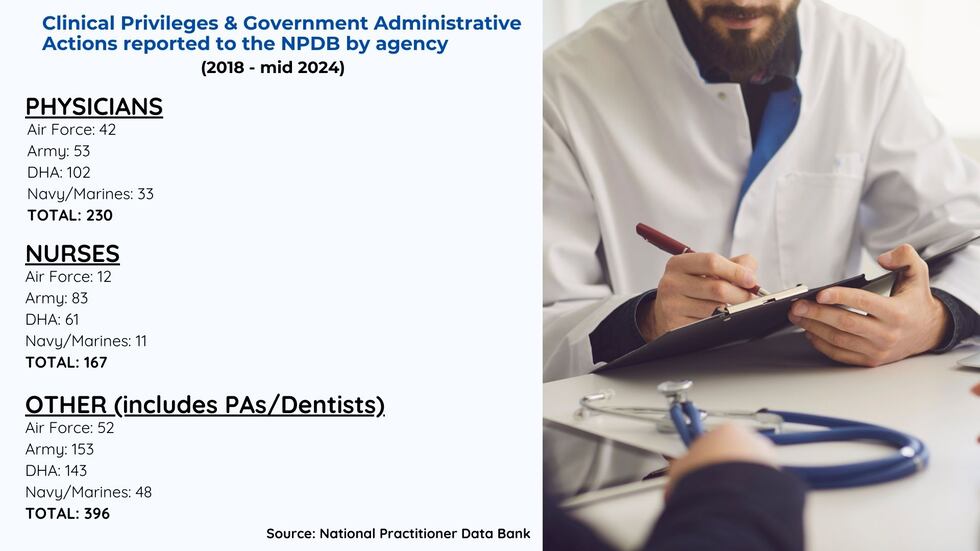
Using that data, InvestigateTV discovered more than 200 military doctors, nearly 170 nurses and almost 400 other medical professionals including physicians’ assistants and dentists have been reported to the National Practitioner Data Bank for disciplinary action since 2018. Nearly 300 military providers were reported for malpractice payments in that same timeframe.
“This is obviously a big problem. It’s a bigger problem than the attention that it’s gotten in the news,” said U.S. Rep. Joaquin Castro (D-TX) “These are people who are serving our country, but they’ve been wronged, and they deserve better than they’re getting now.”
Congressional lawmakers pitching military malpractice law as Supreme Court effort rolls on
As Ryan Carter and his team lobby the Supreme Court, Castro and others are lobbying their colleagues in Congress. They are fighting for the HERO Act.
The legislation, which has bipartisan support in the House, would allow active-duty military to file lawsuits for malpractice, saying the current claims process is broken.
“What we’re trying to do with the HERO Act is pretty simple. We’re trying to give military members the same rights that civilians have,” Castro said.
The rights Castro alluded to include access to information about medical providers that civilians routinely get. Members of the public can learn about problematic providers from malpractice lawsuit filings as well as disciplinary actions taken against medical providers that are made public by state boards across the nation.
“Now don’t get me wrong, these are also military members who are generally honorable people who are often trying their best. But I’m uncomfortable with a situation where if a medical professional knows that there is basically no chance that there’s going to be any consequences if they mess up, if they don’t pay particular attention to the procedure they’re carrying out. There is a bad incentive for them then not to take the care they should and not to perform up to a level of care that we would expect,” Castro said.
It’s health care that can end up costing service members their lives, or their quality of life. Ryan Carter and his wife know the cost.

While the physician involved in Ryan’s procedure has no disciplinary action listed on his public state medical board licensing page and has maintained his privileges at Walter Reed, Carter’s and his wife’s lives have been turned upside down.
The couple has given up so much of what they used to know before Ryan‘s surgery. But despite the challenges they’re facing, they still see their legal battle as a continuation of Carter’s service to the country.
“This can open doors. And if unfortunately, we can’t break through to the Supreme Court, hopefully someone else can pick up the torch and get further than we did,” Casey Cole said.
Have you experienced military medical malpractice? InvestigateTV would like to hear from you.
By clicking “Submit” you agree to our terms and conditions regarding your information and image in our Publicity Release and Copyright License, Terms and Conditions