Secrets, Servers, and Strain: The hidden toll of America’s data center boom
As data centers surge across the U.S., experts warn of rising utility bills and threats to grid reliability
(InvestigateTV) — When Ari Govoni-Young bought her house about 45 minutes outside the nation’s bustling capital, she was looking for an escape. After searching, her family found what felt like a piece of paradise in suburban Virginia – a townhome community with a beautiful view of trees and ample opportunity for seeing animals in the wild.
But over the years, she’s watched her personal oasis go through a transformation – the trees cut down, and the community surroundings turned into a concrete jungle.
“It’s horrible. It’s absolutely atrocious. It’s an eyesore,” she said.
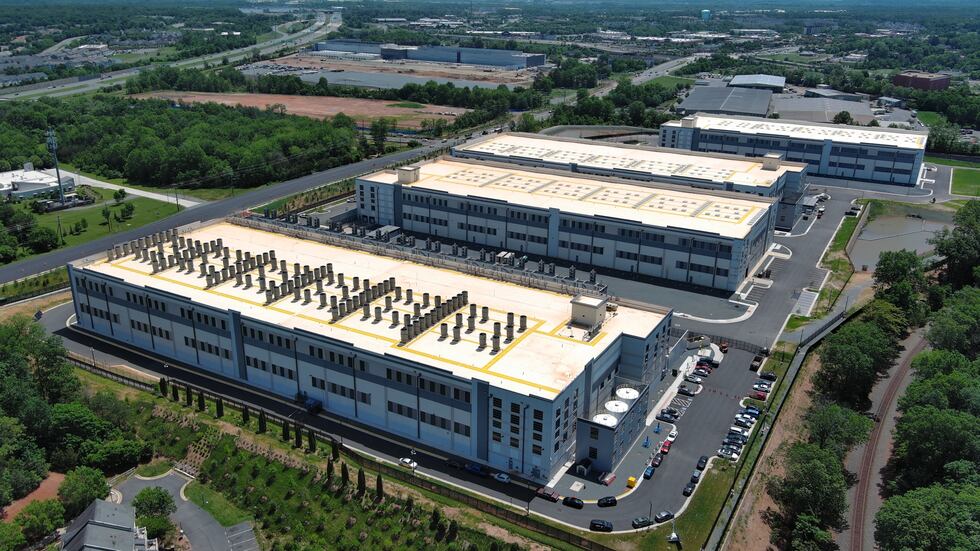
Just 200 feet from the balcony where she used to enjoy morning coffee watching deer scamper through the fields is now a cement structure that rises toward the sky, blocking any pleasant view. It’s a data center as big as four football fields, perched right in her backyard.
Originally, records show the area around her community was slated for mixed-use development – a set of restaurants and shops. But in 2021, it was rezoned to clear the way for the data center, something Govoni-Young and her neighbors say they weren’t aware of until it was too late.
“Unfortunately, our community was the guinea pig. We were the test subject to see, ‘Can we build a data center this close to a community?’ And yes, you can,” Govoni-Young said.
Her community is dealing with the realities of a technology boom that’s impacting towns and cities across America. It’s happening as some of the world’s biggest companies invest in the race to profit from artificial intelligence.
It’s the development of data centers that’s fueling the growth. And critics say consumers are being kept in the dark about how their communities will be impacted by their construction. That can be done with non-disclosure agreements that keep details of the projects secret from residents initially, even though they may end up footing the bill in the long run and dealing with the aftermath of the strain placed on their power supply by data centers.
“The massive energy consumption needs that these single facilities have dwarfs anything else that we’ve ever seen,” said Tyson Slocum, an energy expert with the nonprofit consumer advocacy group Public Citizen. “We’re now seeing not only our data centers presenting unique consumer and environmental impacts, they’re also eroding grid reliability.”
With data centers expanding, so could power expenses for everyday consumers
Data centers are essentially warehouses filled with row after row of computer processors, servers and equipment. They can be used for cloud computing and storage – basically, the machines that make it possible to hold onto your old email and pictures. Lately, they’ve also become a hub for artificial intelligence.
AI is technology that simulates human learning. Things like ChatGPT can answer questions as complex as “tell me the meaning of life” or create something as trivial as the lyrics to a song about your dog’s terrible breath.
And the data centers that fuel AI are changing our world and the landscape of the communities that house them, as companies such as Amazon, Google, and Meta funnel big money into the industry nationwide.
At an April GOP Oversight hearing on Capitol Hill, Josh Levi, president of the Data Center Coalition, an industry trade group, said, “Data centers are vital to enabling critical and emerging technologies like AI that are essential to U.S. national security, our global competitiveness and economic prosperity.”
But the competition is a power struggle, not just to dominate the AI industry globally, but also to physically provide the energy needed to fuel data centers here at home. It’s a staggering pull on the system.
In a different Congressional hearing in March, Kentucky Republican Congressman Brett Guthrie said, “I spoke with Microsoft. And Microsoft data centers - not all - but some Microsoft data centers can use as much power as the city of Seattle.”
When data centers require that much power, it’s the cities and towns that house them that feel the consequences and field the concerns. Environmental impacts stemming from the loss of green space and farmland to the use of diesel backup generators to power facilities have been a major worry.
But there is another green concern: Power customers from coast to coast worried they’ll have to support the cost of data center expansion with their own pocketbooks.
In Georgia this past February, lawmakers heard from residents worried that data centers could drain state resources and impact their energy and water bills.
And last year, when a proposed data center was discussed in Lincoln, Nebraska, critics pointed to other existing facilities in Omaha that have resulted in power bill hikes, with one man telling InvestigateTV affiliate WOWT, “They have multiple data centers and they’re seeing skyrocketing electric rates.” The power supplier in Omaha told the station it has seen “steady rates with modest increases only”.
Tyson Slocum, the energy expert from Public Citizen, has long been sounding the alarm, warning about the rapid expansion of data centers and the potential ramifications for customers.
“Big tech wants to see someone else pick up the tab for all this expensive infrastructure. And utilities are happy to accommodate by building the infrastructure and then billing all consumers within the service territory for that infrastructure,” he said.
Slocum testified before Congress in April, telling lawmakers that working families shouldn’t pay higher electric rates to fund more infrastructure that serves tech companies with profits in the billions.

Industry leaders are quick to refute claims that they’re passing the bill onto consumers, despite critics who say otherwise.
The Data Center Coalition trade group told InvestigateTV in an emailed statement, “The data center industry is committed to paying the full cost of service for the energy it uses, and recent reports confirm that it is currently doing so. The Virginia Joint Legislative Audit and Review Commission noted that data centers pay their full cost of service for the energy they use, while the Arizona Corporation Commission added that the industry is currently paying its share of power generation and infrastructure costs.”
Meta, a major player in the data center industry, said in a statement to InvestigateTV, “A foundational part of our program is to cover the costs utilities incur to serve our data centers. This often results in Meta covering broader grid-upgrades that benefit all utility customers.”
The company pointed us to a robust website detailing Meta’s approach to clean, renewable energy when it comes to data centers. But that site doesn’t list any specific actions taken to prevent costs from trickling down to consumers in areas where their data centers are located.
‘I don’t understand why that should be a secret’: NDAs common in data center development
Transparency has also become another hot-button issue as more and more data centers are built across America. Many people are unaware that the concrete behemoths that could impact their power bills are even being built.
“Someone wants to come build something, they should be proud and be willing to come at the very first opportunity in front of your community,” Slocum said.
But InvestigateTV discovered many people are being kept in the dark about the development of data centers in their backyard, with non-disclosure agreements, or NDAs, used as the projects get off the ground. Those agreements require local governments to keep the details secret until certain water and power deals are locked.
InvestigateTV sent public information requests to dozens of communities in all 50 states, asking for copies of any NDAs signed as part of data center development.
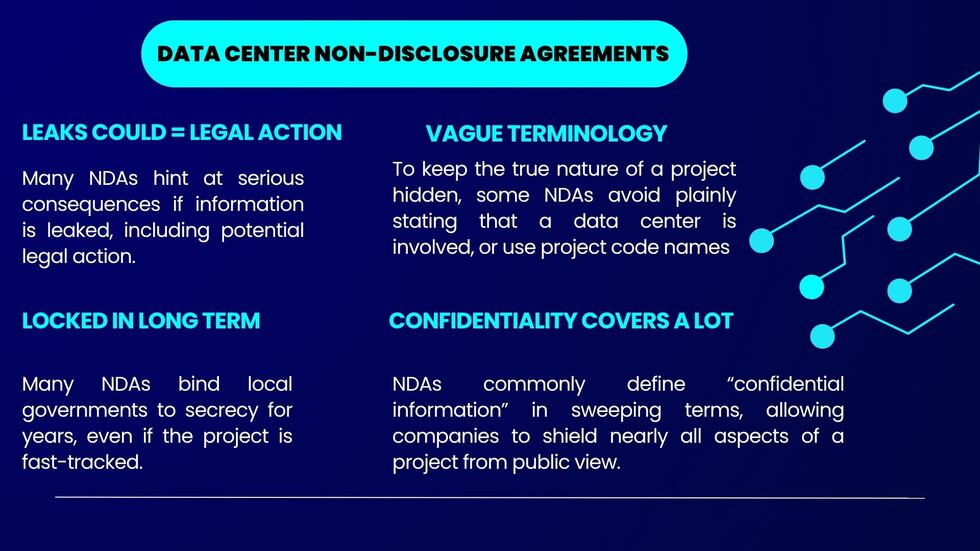
Documents show that some agreements extend for years even if a project is never approved. Some involve facilities that could nearly triple the size of Disneyland. And many have requirements to keep the public in the dark.
Specifically, we found:
- One non-disclosure agreement obtained from Virginia never even mentions the phrase “data center, instead referring only vaguely to development.
- In another agreement with a Virginia county, Microsoft explicitly stated that the county should “limit its disclosure and redact disclosed materials to the maximum extent permitted” under all applicable FOIA exemptions.
- An agreement signed in Indiana covered a project that could span as many as 400 acres.
- Two NDAs obtained from Texas warned that leaks about the project could lead to legal action against the jurisdiction.
- One Texas NDA set a five-year confidentiality period – long enough for a project to be planned, approved and potentially built without full public scrutiny from start to finish.
“We’ve heard directly from folks that very often under the terms of the NDA, the big tech companies reach a tentative agreement with local officials. And then the local officials say, ‘Ok, now we go to the public’. But by then it’s a done deal,” Slocum said. “Ninety nine percent of all of the details have been negotiated in private between big tech’s lawyers and local officials. And by the time you’ve got a public hearing the presentation is, ‘Here is the deal that’s on the table. Take it or leave it.’”
InvestigateTV asked six of the nation’s biggest data center companies about the use of NDAs and other issues related to data centers. Only Meta and Amazon responded, although Amazon didn’t specifically address confidentiality agreements in the brief statement it provided.
The Data Center Coalition said NDAs protect company-specific information, which some may be hesitant to make public, given the competitive nature of the industry.
InvestigateTV repeatedly asked the organization to sit down for an on-camera interview, but no opportunity was provided.
In an emailed statement, a spokesperson for the Data Center Coalition said, “An NDA between a locality and a company does not restrict information shared with the locality, including information related to water or power. On the contrary, the protections provided by NDAs may result in an increase in the amount and detail of information shared with localities as projects are considered.”
Meta’s team told InvestigateTV that maintaining confidentiality increases the speed and efficiency of projects, also pointing out that sometimes the company may choose not to move forward, so NDAs keep it from pulling communities through the ups and downs of the process.
Experts warn about lack of preparedness for strain data centers put on the power grid
But data center development, experts warn, can still happen under a veil of secrecy even though the projects may put a substantial strain on individual customers and the nation’s power grid.
Jim Robb is president and CEO of the North American Electric Reliability Corporation – the regulatory group that’s charged with ensuring the security and reliability of the nation’s power grid.
“The data centers and the load growth associated with that has just put a heightened sense of urgency into a number of things we’ve been concerned about,” he said in an interview with InvestigateTV.
As more and more data centers come online across the nation, it’s testing the grid, according to Robb, who called the expansion a “daunting challenge” for the country.
The system itself has already seen troubling results from the challenges posed by data centers. An April presentation made by the North American Electric Reliability Corporation to federal regulators highlighted two major incidents of concern in Virginia.
One of those incidents from last summer was considered a “near miss” involving 60 data centers that simultaneously dropped offline. As a result, a huge amount of electricity already on the grid had nowhere to go. Experts like Robb compared it to having a large nuclear power plant come online immediately and unexpectedly, creating a massive energy imbalance that could have led to blackouts.
“The close calls are very concerning. If they come off the grid in ways that we don’t understand, can’t predict, and can’t manage, they can introduce oscillations in the grid instability, which can start to impact people’s ability to use power in their homes,” Robb said. “That’s one of the reasons we want to make sure that they’re well understood, well modeled, and well controlled when they come onto the grid.”
Consumer advocates say that’s why there should be more regulation and more tools to respond to the strain data centers put on the system. Until that happens, stakeholders, including the industry itself, utilities, and impacted communities, all agree there should be more research, more collaboration, and more communication.

Ari Govoni-Young, the woman who watched a data center sprout up just steps from her home, wishes there had been more information provided long before development was formalized. Her area of Virginia has now become known as Data Center Alley because of the sheer number of facilities that have been developed in a short radius.
Her advice to others who could see the same landscape change in their future?
“Get to the meetings. Be a voice. Be an advocate for your community. That’s all we can do,” she said.
Data Center Coalition’s full statement to InvestigateTV:
“Data centers strive to be good neighbors in the communities where they operate. They build in areas where local rules allow, and work with residents to limit impacts. In return, data centers bring billions of dollars in investment, create well-paying jobs, and generate tax revenue that helps fund schools, roads, public safety, and other community priorities. Nationwide in 2023, the industry supported nearly 4.7 million jobs and contributed $162 billion in local, state, and federal tax revenue.
As is the case with other highly competitive industries, data center companies may use NDAs when considering projects to protect company-specific, competitive information. An NDA between a locality and a company does not restrict information shared with the locality, including information related to water or power. On the contrary, the protections provided by NDAs may result in an increase in the amount and detail of information shared with localities as projects are considered. Absent NDAs, some companies in highly competitive industries seeking to invest and locate in a jurisdiction may be hesitant to share proprietary information key to business competitiveness with localities and other third parties. Data center companies are continuously working with local, state, and federal lawmakers and regulators to provide them with relevant information and to follow applicable laws at each level of government.
Data centers are highly efficient facilities that also enable energy savings and efficiencies for homes, businesses, utilities, and other end users by providing the digital infrastructure that supports smart thermostats, smart meters, automated lighting, managed EV charging, and many other energy efficiency platforms.
The data center industry has been a leader in expanding access to clean energy and remains committed to sustainability and innovation. Half of all commercial contracts for renewable energy in the U.S. are by companies that operate data centers. The data center industry is also actively supporting next-generation technologies from utility-scale hydrothermal power and long-duration storage to the development of small modular reactors (SMRs) and nuclear fusion efforts. Data center companies invest heavily in distribution and transmission-level infrastructure that benefits all electricity users, helping modernize the nation’s electricity grid.
The data center industry is committed to paying the full cost of service for the energy it uses, and recent reports confirm that it is currently doing so. The Virginia Joint Legislative Audit and Review Commission noted that data centers pay their full cost of service for the energy they use, while the Arizona Corporation Commission added that the industry is currently paying its share of power generation and infrastructure costs.
As new loads come onto the system, there’s a need for greater communication, collaboration, and transparency among all stakeholders, including utilities, grid operators, regulators, and customers, to ensure the continued reliability of the grid. We fully recognize that grid planning and management are the responsibility of utilities and grid operators, but DCC is committed to leaning in as an engaged partner to help ensure we collectively meet this critical moment.”
Meta’s full statement to InvestigateTV:
- Maintaining confidentiality during project development increases efficiency and speed by enabling all stakeholders to remain focused on the needs of the project. Also, sometimes we choose not to invest in a site we are considering, so we do not want to pull entire communities through the ups and downs of our due diligence processes.
- A foundational part of our program is to cover the costs utilities incur to serve our data centers. This often results in Meta covering broader grid-upgrades that benefit all utility customers.
- You can read more about our energy approach here.
- In addition, we also invest in additional local infrastructure improvements, like roads and water infrastructure.
- We work closely with utilities and power providers to plan for our energy needs years in advance of our data centers being operational, and enter into commercial agreements with them for the power they supply to our data centers.
- On top of that, to meet our sustainability goals, we have additional arrangements with utilities and power developers that enable us to add clean and renewable energy to the grid to match 100% of our annual energy to meet our sustainability goals – this is in addition to the energy we purchase from utilities as part of our commercial agreements to power our data centers.
- Meta data centers support the local economy through hiring locally - including construction and operational jobs - sourcing from local businesses whenever possible, and supporting local schools and nonprofits.
- We are also proud of our grant programs that support projects that address critical community needs, such as putting the power of technology to use for community benefit, connecting people online or off, giving people the power to build strong and sustainable communities, and improving local science, technology, engineering, arts and math (STEAM) education.
- We are continually looking at innovative ways to bring new energy to the grid to maximize the positive impact of the energy projects we support – and we’re committed to working with the industry to transform the grid.
- You can find our recent announcement on nuclear and geothermal linked.
Amazon’s full statement to InvestigateTV:
“We partner with communities for mutually beneficial programs and engagements when we grow in a location. AWS is constantly innovating and improving our data centers to be a good neighbor and minimize the impacts on residents and the environment.”
Copyright 2025 Gray Media Group, Inc. All rights reserved.