Historical marker honors ‘Shep’ Mullens, McLennan County’s first Black county commissioner
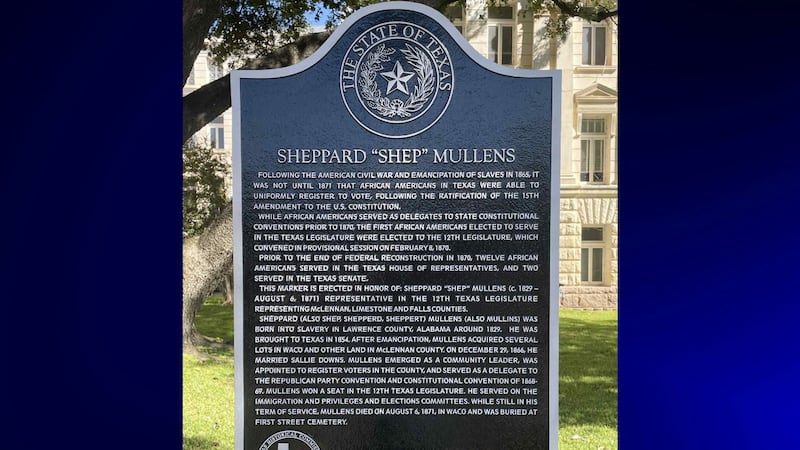
WACO, Texas (KWTX) - McLennan County officials on Tuesday dedicated a historical marker honoring Sheppard “Shep” Mullens, the county’s first Black county commissioner who also served in the Texas House of Representatives.
Members of the McLennan County Commissioners Court, the McLennan County Historical Commission and others gathered on the courthouse lawn for the unveiling of the Texas Historical Commission marker approved by the 88th Texas Legislature.
The marker is among others established under Senate Bill 667, also known as the Texas Black Reconstruction Legislators Recognition Act, and authored by State Sen. Royce West. The legislation directed the Texas Historical Commission to honor Blacks who served in the Texas Legislature between 1870 and 1875 during post-Civil War reconstruction.
Mullens was born enslaved in Lawrence County, Ala., in 1828, and arrived in Texas in 1854 as a bondsman. By 1865, he began building a new life in freedom, acquiring property in Waco and McLennan County. He married Sallie Downs in 1866.

According to Mullens’ bio outlined at Tuesday’s ceremony by County Judge Scott Felton and Clint Lynch, chairman of the McLennan County Historical Commission, Maj. General Charles Griffin appointed Mullens to serve on the McLennan County board of voter registration in 1867. That year, Mullens also helped develop the platform of the first Republican Party convention in Texas.
In 1868, Mullens was elected to the Texas Constitutional Convention, where he served on the committees for public lands, commerce and manufacturing, while advocating for equality and opportunity for all Texans, Lynch said.
Gen. Joseph J. Reynolds, commander of the Department of Texas, appointed Mullens a McLennan County commissioner in 1868, and appointed him the following year to a full, four-year term.
Later that year, Mullens won election to the 12th Texas Legislature, serving in the House.
“He championed education for all children, opposed segregation and supported state police and militia reforms to protect the newly freed population from violence,” Lynch said in his remarks.
Mullens died in 1871 and is buried at First Street Cemetery in Waco.
“Form bondage to elected office in less than a generation, his life stands as a testament to perseverance, faith and civic courage,” Lynch said. “He carried freedom into public service and left behind a legacy that continues to inspire.”
The late McLennan County Commissioner Lester Gibson led a commissioners court movement in 2009 to honor Mullens by naming the county visitation center near the McLennan County Jail on Highway 6 in Mullens’ honor.
Copyright 2025 KWTX. All rights reserved.